
How to Think About Property Maintenance (Particularly Your Roof) | Part 1 of 3: Befriending the Building, Establishing a Comfortable Facility Maintenance Mindset
Most facility managers treat their building like a monster that needs to be battled. Kenny's been fighting this fight for years, driving to hardware stores three times a week, patching problems that keep multiplying. What if the building wasn't your enemy? What if you could shift from 50% responsible for everything to just 10% oversight with 90% of the headache outsourced to people who actually specialize in roofing?
🔲 You're rewarded when things go right (rarely), but crucified when anything fails (constantly)
🔲 The "me versus the building" mindset creates defensive territory management and burnout
🔲 Budget paralysis keeps you stuck between $5 buckets and $100,000 replacements
🔲 Communication breakdown (not materials or labor) is the #1 roofing stressor
🔲 The 80/20 rule: outsource 80% of roof responsibilities, keep 10% strategic oversight
🔲 Forward thinking = relaxation. The more you can think ahead, the more you can breathe
🔲 Kenny doesn't need to become a master roofer. Kenny needs to become a master delegator
This isn't about materials or contractors yet. That's Part 2 and Part 3. This is about your relationship with the building. This is about making peace with 100,000 square feet of concrete, steel, wires, pipes, and yes, that flat roof you've been avoiding.
Kenny Puts His Boots On
It's 6:47 AM. Kenny's truck smells like coffee and hardware store receipts.
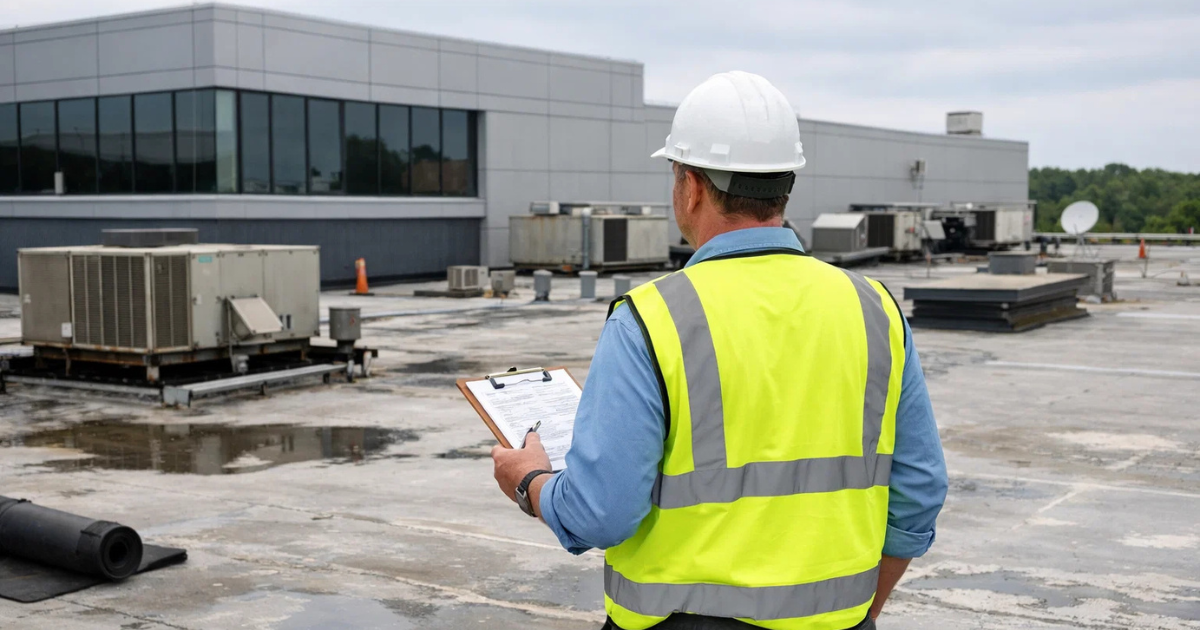
He's the facilities guy for a 240,000 square foot manufacturing building in Northwest Indiana. Three buildings, actually. The main production facility, the warehouse, and the office annex. Plus the parking lot, the loading docks, the break rooms, the bathrooms, the HVAC units (all twelve of them), the landscape, the fence, the railings, the roof, the roof, the roof.
The roof.
Kenny doesn't think about the roof every day. But he thinks about it enough that it's become a low grade background hum of stress. Like tinnitus, but for facility managers.
He's been to Menards twice this week already. Wednesday it was the silicone caulk because the rubber stuff from last year didn't hold. Friday it was some kind of foam-in-a-can situation because there's a spot near HVAC Unit 7 that just keeps weeping water into the ceiling tiles.
Nancy from finance asked him last month, "Kenny, how much have we spent on roof patches this year?"
He didn't have an answer. Because it's not "roof patches." It's spread across a dozen trips. Small purchases. $47 here. $83 there. Maybe $1,200 total? Maybe $2,500? It's death by a thousand cuts, but the cuts are small enough that nobody notices except Kenny.
And the building.
The building notices. The building is keeping score.
Me Versus The Building: The Defensive Territory Mindset
Most facility managers develop what we call the Defensive Territory Mindset.
It sounds like this,
"This is MY building. I know every pipe. Every wire. Every corner. I've patched that wall six times. I've fixed that door handle twice. I know where the hot water heater is. I know which breaker controls what. This is my domain. If I bring in an outside contractor, it's like admitting I failed."
Kenny is a Can-Do Guy. If anyone can do it, Kenny can.
But here's the problem. Kenny's been doing it for eight years, and the building is still winning.
Not because Kenny isn't skilled. Not because Kenny isn't trying. But because one human cannot out maintain a building that's aging 24 hours a day, 365 days a year, while also managing twelve HVAC units, three bathrooms, a parking lot, landscape, and oh yeah, a full time job supervising the production floor.
The Defensive Territory Mindset says, "If I could just rip the roof off myself and put a fresh one down, I'd save the company money. Why should I bring in a professional crew charging $40/hour when I could do it myself for my salary?"
This is noble. This is admirable. This is also insane.
Kenny's value to the company isn't in his ability to install roofing membrane. It's in his ability to keep operations running smoothly while making strategic decisions about when to handle something in-house versus when to delegate to specialists.
But the Defensive Territory Mindset makes delegation feel like failure.
Budget Paralysis: The $5 Bucket Versus The $100,000 Replacement
Nancy in finance has allocated $10,000 per month for facilities maintenance.
That $10,000 has to cover,
🌿 Landscape maintenance
🅿️ Parking lot repairs
🎨 Interior paint and carpet
❄️ HVAC filters and minor repairs
🚰 Plumbing issues
⚡ Electrical upgrades
🧼 Cleaning supplies
🏠 And the roof
The roof is always last on the list. Because the roof is expensive. And the roof isn't screaming (yet).
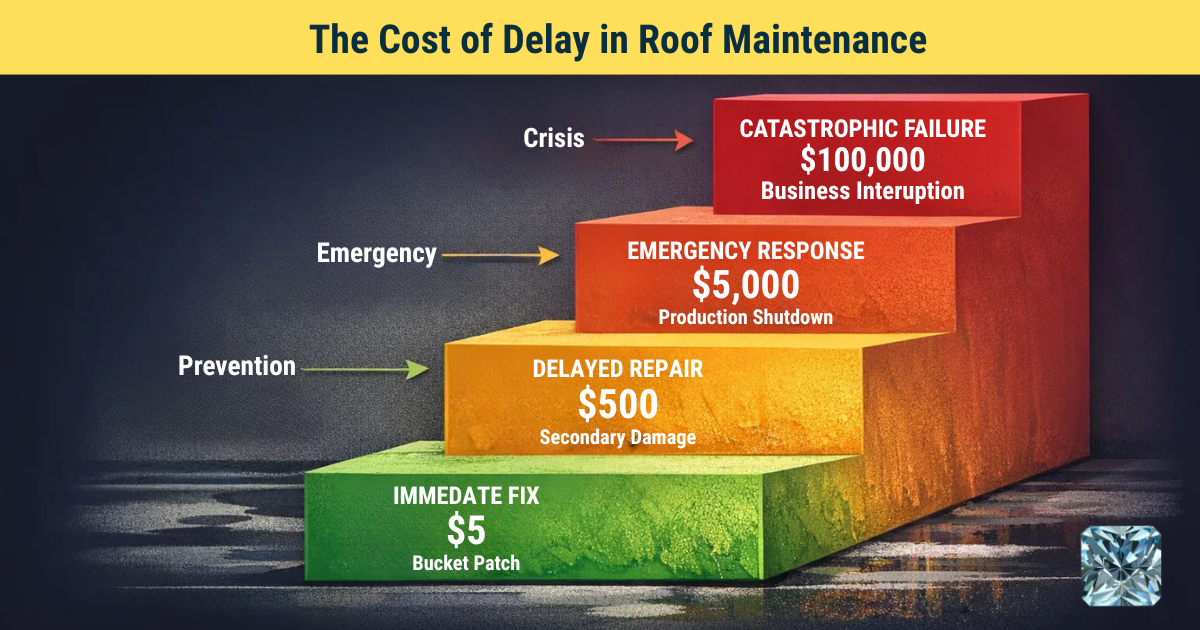
So Kenny grabs another bucket. Another tube of caulk. Another roll of tape. Because $5 today feels better than $5,000 next month.
But here's what nobody tells you about budget paralysis:
The building doesn't care about your budget. The building is deteriorating on a schedule. UV rays don't stop because Nancy only allocated $10,000 this month. Gamma radiation doesn't pause because you're trying to save up for the fence replacement.
The roof is aging. Every single day.
🧱 The old plastic is getting brittle
🧴 The rubber sealant is expiring
🧵 The seams are separating
💧 The ponding water is accelerating biological breakdown
❄️ The freeze thaw cycles are creating micro cracks
And every month Kenny waits, the $5 fix becomes a $500 fix, which becomes a $5,000 emergency, which eventually becomes the $100,000 crisis replacement that shuts down operations for two weeks and gets Kenny called into a conference room to explain why he didn't do something sooner.
Communication Breakdown: The Real Roof Problem
Here's the data nobody talks about,
The #1 complaint in commercial roofing isn't materials. It's not labor. It's not pricing. It's communication breakdown.
Promises broken. Timelines stretched. Phone calls that don't get returned. Contractors who ghost for weeks. Work that starts but never finishes.
But here's what's interesting: Kenny is experiencing communication breakdown on the inside, too.
When was the last time Kenny sat down with Nancy from finance and said:
"Nancy, I need you to understand that our roof is 18 years old. We've been patching it for six years. I've spent roughly $2,300 this year on temporary fixes. But the reality is we're maybe two years away from a total failure. If we don't allocate $40,000 to $60,000 for a restoration coating in the next 12 months, we're going to be looking at $120,000 to $180,000 for a full replacement within three years. And that replacement will shut down the west wing for at least ten days."
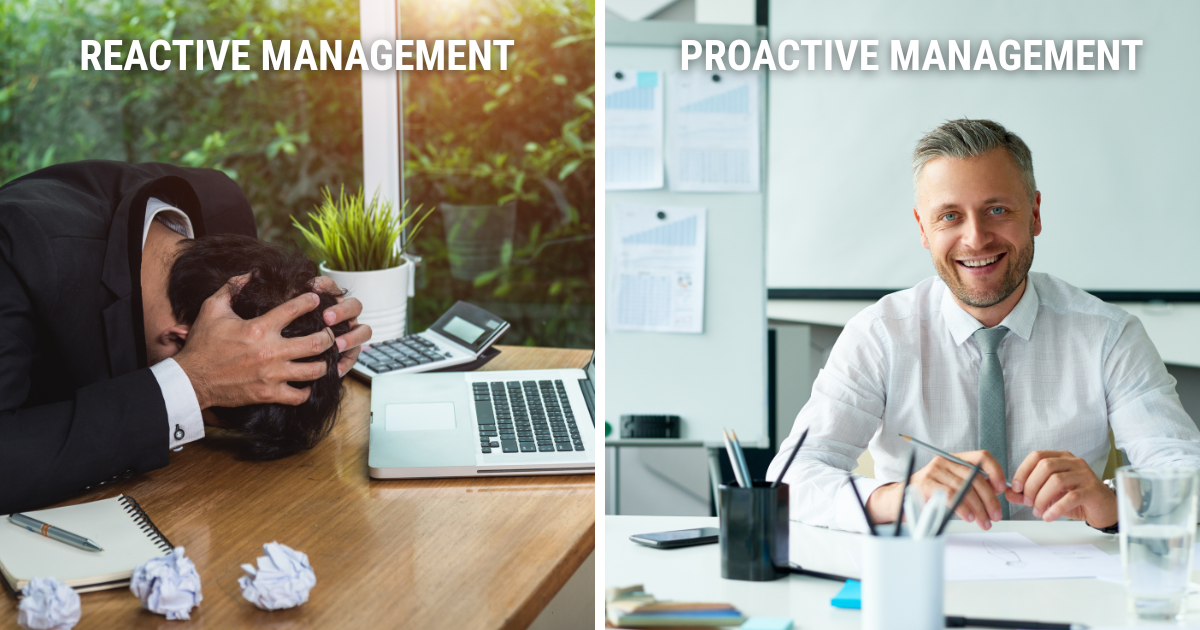
Kenny hasn't had that conversation. Because Kenny doesn't have the data. Because Kenny is stuck in reactive mode. Because Kenny is fighting the building instead of managing the building.
Communication cannot be verbal exclusively. Communication cannot be video exclusively. Communication has to be multidimensional.
✍️ In writing (email summaries, maintenance logs)
👁️ Visual (photos, thermal scans, drone footage)
🖨️ Printed (hard copy reports for executives who don't read email)
📅 Consistent (quarterly reviews, not crisis meetings)
🔍 Transparent (no withholding bad news because you're embarrassed)
When Kenny finally gets the data, the visuals, the projections, and the options clearly communicated to Nancy and Bill (the building owner), then decisions can be made strategically instead of reactively.
The Weight of Responsibility: Why Kenny Can't Sleep
Kenny carries weight that most people don't see.
If anything goes well in the building, Kenny rarely gets praised. If anything goes wrong in the building, Kenny's hide gets braised.
The building is Kenny's baby. But it's a baby that weighs 240,000 square feet and never stops needing attention.
• The wires• The pipes• The bricks• The function• The complaints• The opinions• The budget constraints• The priority list that never gets shorter
Everybody thinks there's room for improvement. But they don't see the list of priorities, the budget reality, the constraints, the fact that Kenny has already been to the hardware store eleven times this month.
Kenny is a gopher. He goes for bolts. He goes for paint. He goes for cleaning supplies. He goes for buckets of roof sealant that claim to last 100 years but fail in 18 months.
It's Kenny versus the building. And the building is winning.
The Shift: What If The Building Could Be Your Partner?
What if the building wasn't your enemy?
What if you could think about the building the way you think about your truck?
You don't rebuild the engine yourself. You take it to a mechanic. You don't replace the transmission yourself. You delegate that to someone who specializes in transmissions.
But you do
• Check the oil• Monitor the dashboard warnings• Schedule preventive maintenance• Keep records of service history• Make strategic decisions about when to repair versus replace
That's 10% responsibility. Strategic oversight. Documentation. Decision-making.
The other 90% is delegated to people who specialize in engines, transmissions, brakes, tires.
Why can't the roof work the same way?
What if Kenny's job wasn't to install roofing membrane, but to:
✅ Know what material is on the roof
✅ Know when it was installed
✅ Know what the expected lifespan is
✅ Know who the roofing partner is
✅ Know the maintenance schedule
✅ Know the early warning signs of trouble
✅ Communicate roof status to finance and ownership clearly.
That's 10% responsibility. That's strategic. That's sustainable.
The other 90%? That's outsourced to professionals who specialize in commercial flat roofing. Who have the materials, the labor, the equipment, the insurance, the expertise.
Forward Thinking = Relaxation
Here's the formula,
The more forward you can think, the more you can relax.
When you're stuck in reactive mode, every phone call is a crisis. Every leak is an emergency. Every decision is made under pressure with incomplete information.
But when you shift to proactive mode, you have:
• Scheduled inspections (semi-annual roof assessments)
• Maintenance logs (documented history of every repair, every coating, every inspection)
• Preventive plans (5-year roadmap for roof restoration, replacement, or coating)
• Budget clarity (Nancy knows what's coming, not surprised by emergencies)
• Vendor relationships (a roofing partner who knows your building, not a stranger you call in panic)
Forward thinking doesn't mean you have zero stress. It means the stress is manageable because you have a plan.
Life Is A Matter of Priorities
Here's the biggest quote of the whole article,
"Life is a matter of priorities. You always do that which is most important, then figure out when to do the rest."
Kenny's problem isn't that he's lazy. Kenny's problem is that everything feels equally urgent.
The roof is important. But so is the HVAC. But so is the parking lot. But so is the bathroom sink that keeps dripping. But so is the landscape. But so is the fence.
When everything is urgent, nothing gets prioritized properly.
So how do you prioritize the roof? You ask,
1. What's the consequence of delay? (Roof failure = operational shutdown, mold, structural damage, lawsuits from tenants)
2. What's the timeline to failure? (Roof coating buys 10-15 years, patching buys 6-18 months, ignoring it = 2-3 years to catastrophic failure)
3. What's the cost of prevention versus emergency? (Preventive coating = $4/sf, emergency replacement = $9/sf + business interruption)
When you run the numbers, the roof moves up the priority list. Not because Kenny loves roofing. But because Kenny loves avoiding $150,000 emergencies.
What We're Building Toward (Parts 2 & 3 Preview)
This article isn't about materials yet. It's not about contractors yet. It's not about financing yet.
This article is about your mindset.
Because if you don't shift from "me versus the building" to "me managing the building strategically," then it doesn't matter what material you pick or which contractor you hire. You'll still be stuck in reactive mode, stressed out, driving to the hardware store, fighting a battle you can't win.
Part 2 of this series will cover,
• The 80/20 outsourcing strategy (how to delegate 90% of roof responsibilities while keeping 10% strategic oversight)
• Preventive maintenance systems that actually work
• Communication frameworks that eliminate surprises
• How to move from reactive crisis mode to proactive planning mode
Part 3 of this series will cover,
• SBA 504 financing (how to stretch a $100,000 roof project over 10 years with government-backed loans at 4-6% interest)
• Working with commercial lenders who understand facility improvement investments
• How to present the roof plan to finance without getting shut down
• Making the parking lot, signage, and exterior renovation all achievable within 4 years
But first, you have to make peace with the building.
Free Resource: The Facility Maintenance Priority Matrix
Stop Guessing. Start Planning.
Get our Facility Maintenance Priority Matrix and finally answer,
✅ What breaks first if I ignore it?
✅ What's actually draining my budget through inefficiency?
✅ Where should I invest limited resources first?
✅ How do I communicate priorities to finance without panic?
This isn't another generic maintenance checklist. This is a decision making framework that helps you evaluate time sensitivity, energy costs, realistic resources, relationship impact, and momentum, so you can finally sleep at night knowing you're managing strategically, not reactively.
📧 Email: _________________________________________________
🏢 Commercial Property Address: _________________________________________________
📱 Text (optional): _________________________________________________
We'll send your Priority Matrix immediately, plus you'll get Parts 2 and 3 of this series when they launch.
💚 You're Not Alone In This
If you've read this far, you're probably Kenny. Or you know Kenny. Or you are the building owner wondering why Kenny keeps buying buckets.
Here's what you need to know,
You're not failing. The system is broken.
The system expects one human to manage a building that's deteriorating 24/7 across every department simultaneously. That's not realistic. That's not sustainable.
The goal isn't to become a master roofer. The goal is to become a master delegator.
The goal is to shift from 50% responsibility (and 100% stress) to 10% strategic oversight (with 90% peace of mind).
Part 2 will show you how to build that system. Part 3 will show you how to fund it without breaking the budget.
But today, right now, just make peace with this truth.
The building isn't your enemy. The building is your responsibility. And you don't have to carry it alone.
Continue Your Journey
Ready to dive deeper? These resources will help you think strategically about your commercial property:
1. Finding the Right Commercial Roofing Solution — Explore your options before you commit
2. Before You Fix the Roof, Fix the Conversation — Why communication matters more than materials
3. Modern Roof Chemistry Explained — Understand what's actually on your roof (and what should be)
Deep Dive Into Specific Topics
- YourWarrantySaysWhat.com (Loophole analysis)
- SiliconeIsSilly.com (Why we don't do silicone)
- WeWashFlatRoofs.com (Maintenance matters)
- BigBeautifulRoofBill.com (Transparent pricing guide)
- ModernRoofChemistry.com (What's going on up there?)
- SchoolEnergyRebates.com (Energy grants for schools)
- RelationshipRoofing.com (What matters more?)
- MeetYourInstallers.com (Fabulous families)
- RoofServiceMenu.com (What are my options?)
- TenantRoofRights.com (Tenant questions)

We Love Conversations
 SoHelpful@PristineIndustrialRoofing.com